Impossible Corners – Wall Art That Reshapes Reality 🧠✨
$69.99$44.99
HURRY! ONLY 250 LEFT IN STOCK.
98% customer buy 3-5 items to use daily and gifts for their beloved one
People are viewing right now
Sale ending in
1308
Style
Impossible Corners – Wall Art That Reshapes Reality 🧠✨
$69.99
$44.99
Style
Style
Description
Impossible Corners – Wall Art That Reshapes Reality 🧠✨
YOU SHOULDN'T BELIEVE YOUR EYES!
Because they're not just seeing the world — they're building it.
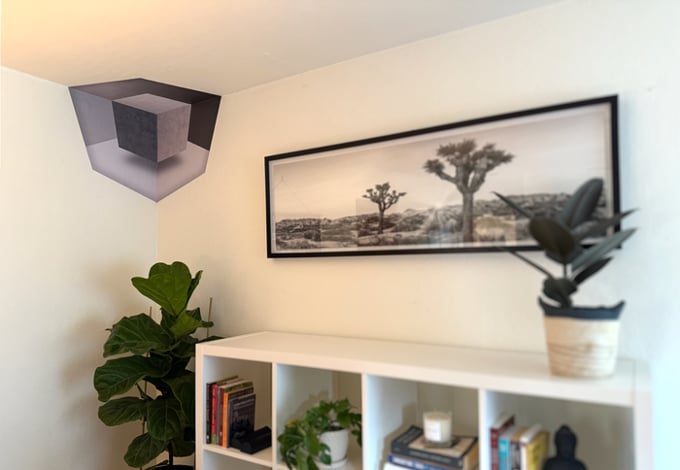
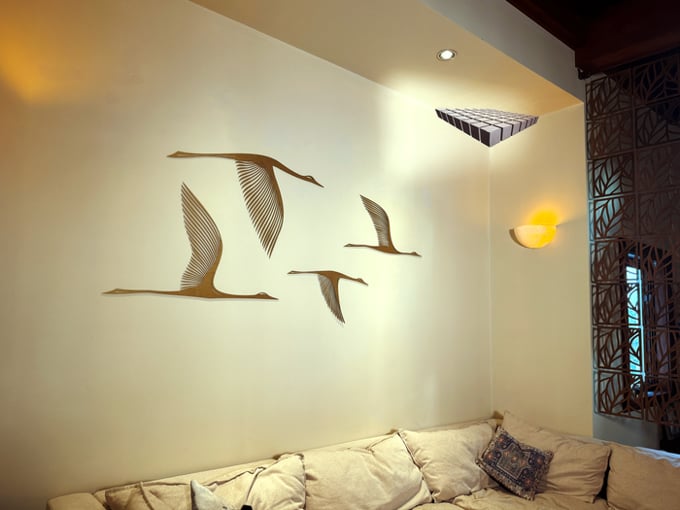
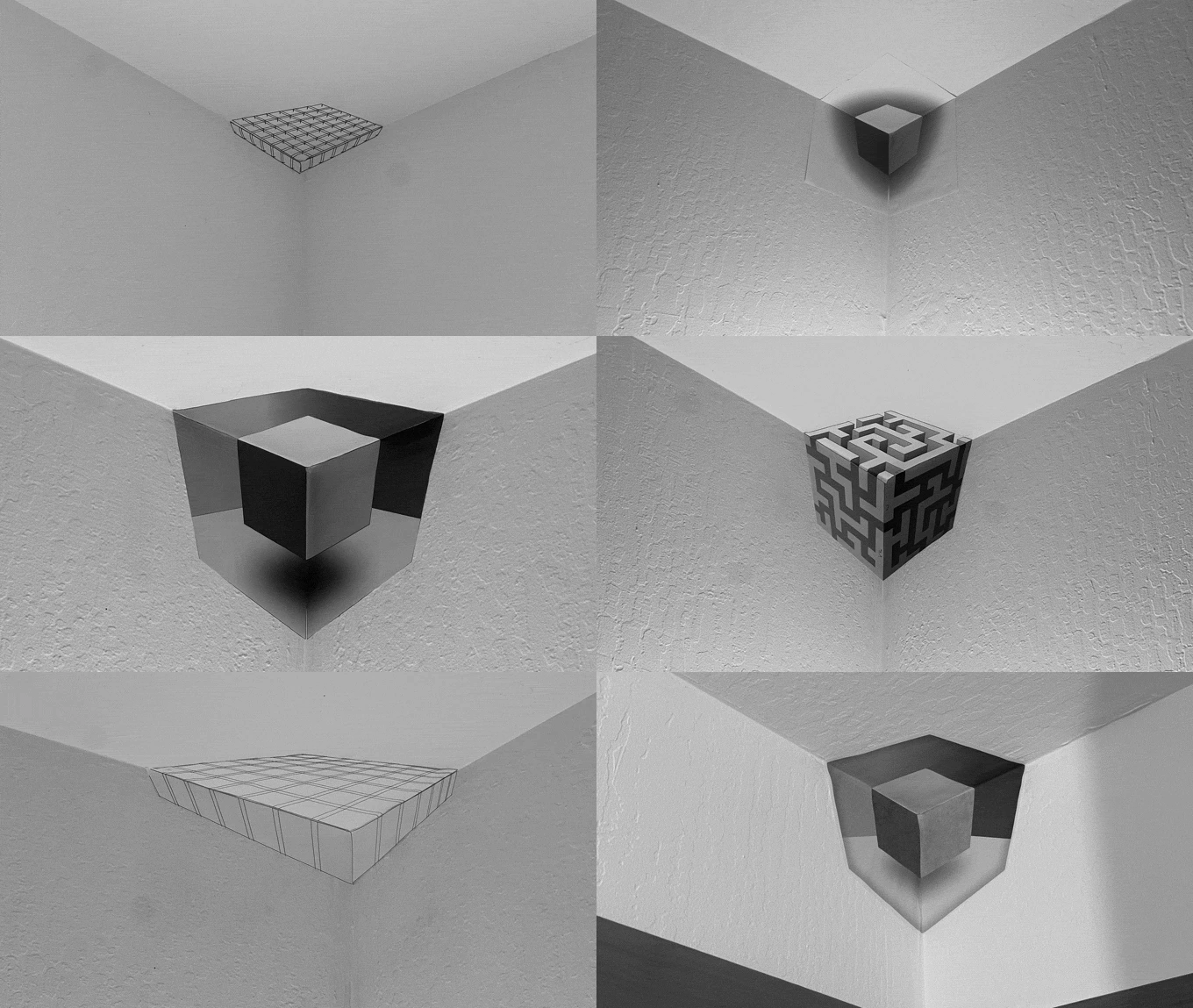
Impossible Corners are illusion-based wall installations that make space behave... strangely. As you move, a floating object appears to twist and shift in impossible ways — revealing the hidden mechanics of perception itself.
Blending science and art, these pieces invite a moment of deep, quiet wonder: a felt realization that your mind doesn't just interpret reality — it constructs it.
And in that moment, something becomes viscerally undeniable. You're not looking at a trick. You're catching your perception in the act.
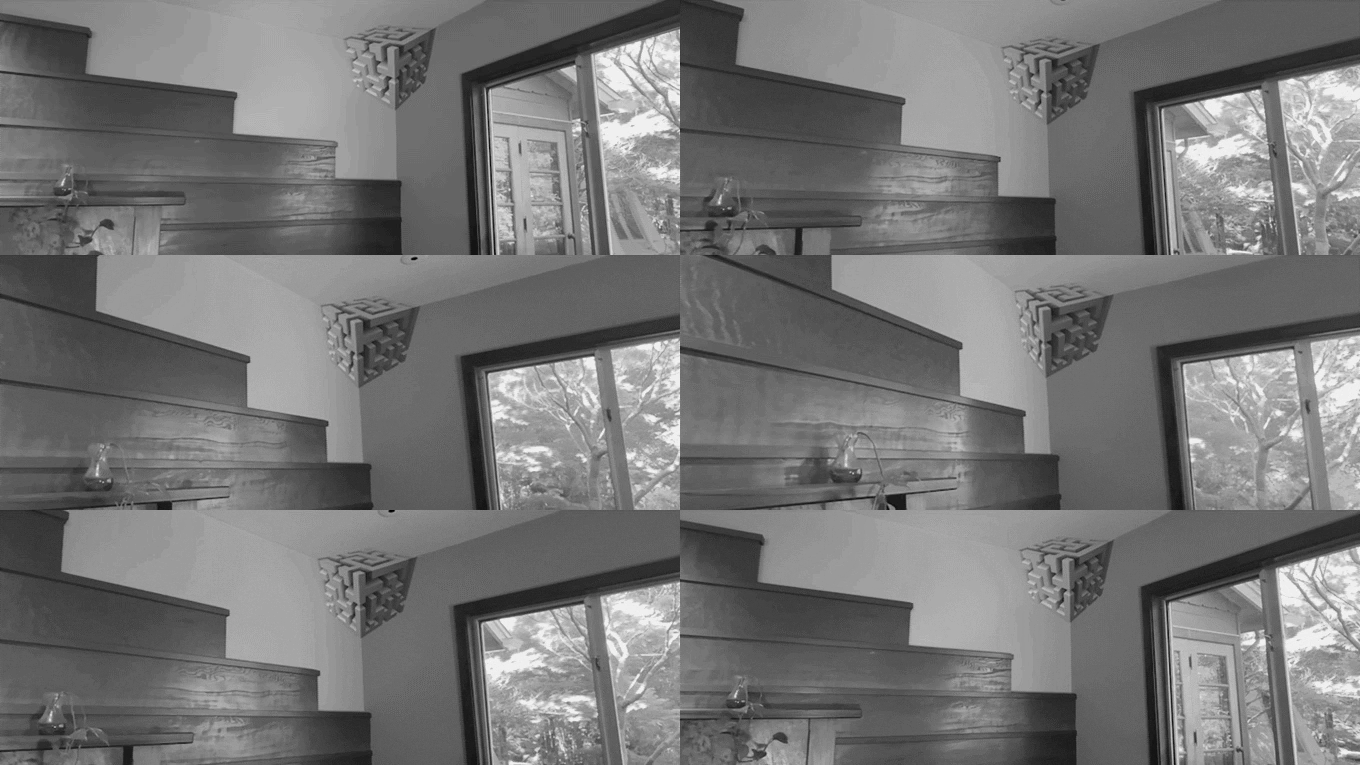
'Cornered': A minimal, mind-warping shape that seems to rotate as you move.
This isn't our first illusion. Our previous , "Slow Dance" , raised over $550,000 and now lives in over 9,000 homes around the world — a simple frame that made real objects move in slow motion.
Now, we're bending not just time, but space.
THE POWER — AND BLINDSPOTS — OF THE MIND
If often starts with a double-take: Wait... how is this happening?
Then you move, and the illusion strengthens . The visual cues streaming into your eyes confirm something completely impossible : an object floating in space, shifting with your position, orienting itself to your gaze.
Even once you understand how this works, the illusion doesn't vanish — it deepens . The more your mind tries to reconcile it, the more it reveals just how powerful, and limited, perception can be.
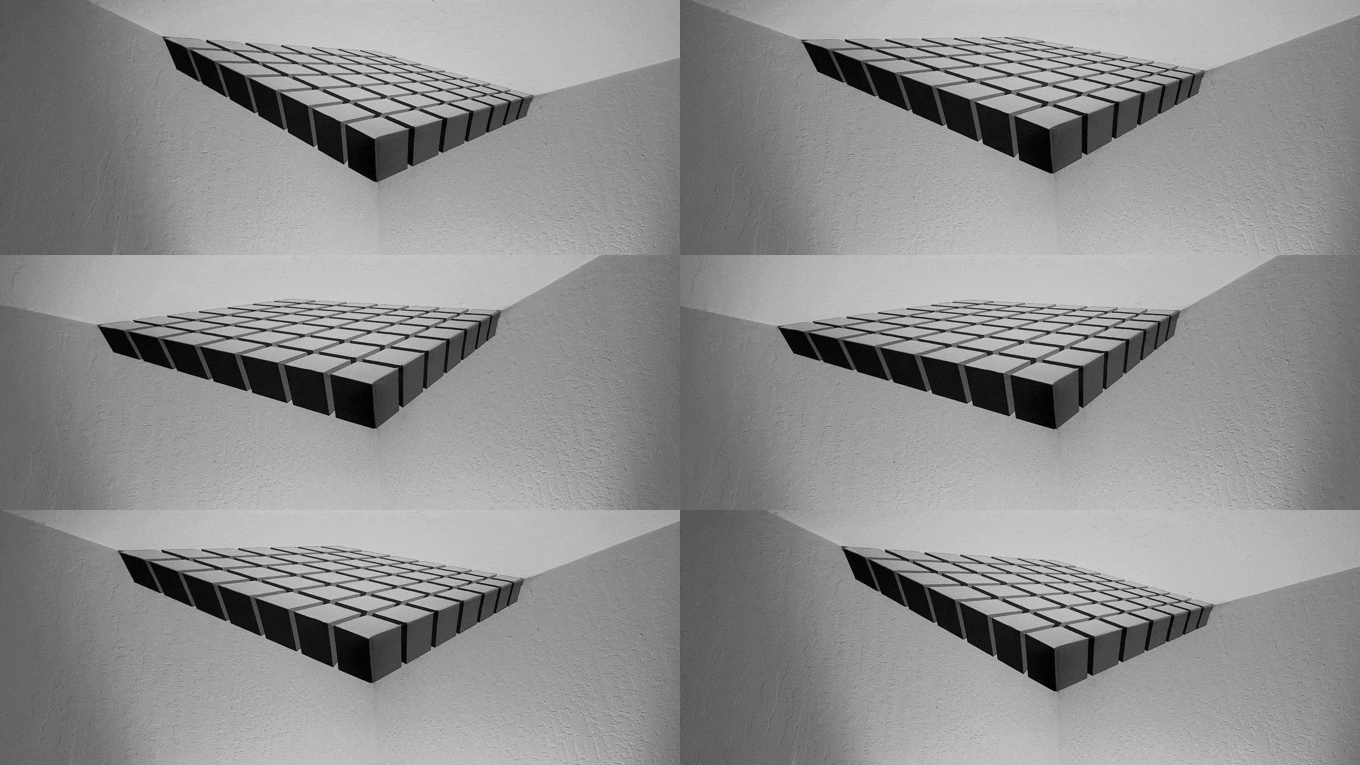
'Worldview,' a grid warped into an impossible angle — one of three initial designs for Impossible Corners
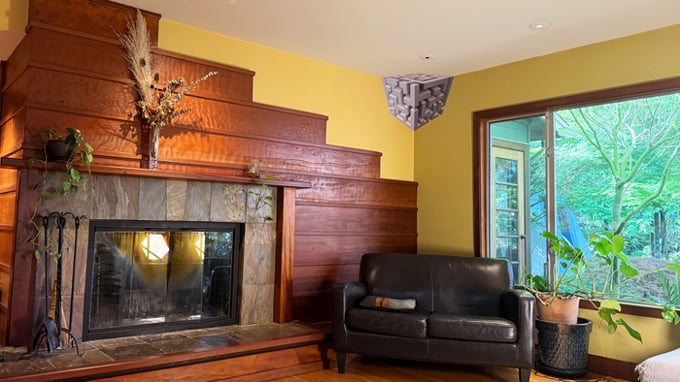
'Pathless,' a 3-D maze that folds space inward, then outward again.
PICK YOUR PORTAL
We are launching with three Impossible Corners models — each a different take on spatial illusion and perceptual shift.
Where will yours live?
And who will you blow away first?
CORNERED
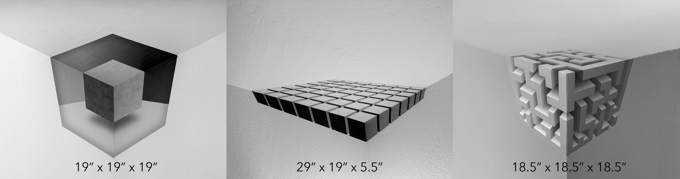
"Cornered": A cube mysteriously floats in an altered corner space. 19"x19"x19"
PATHLESS
"Pathless": A 3-D maze keeps moving between the known and unknown. 18.5"x18.5"x18.5"
WORLDVIEW
"Worldview": A cubic array has us running in a different world. 29"(Left) x 19"(Right) x 5.5" (Height)
HOW DOES IT WORK?
The first time someone walked into my studio and saw one installed, they gasped, and slowly started moving around the space as if orbiting a magic trick. I realized then — it doesn't just look strange. It feels strange.
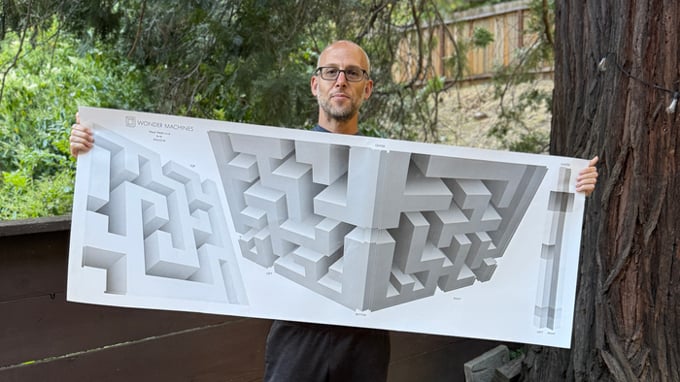
The illusion is deceptively simple — and even once you know how it works, it can still feel unbelievable. Three peel-and-stick panels (repositionable, paint-safe) are precisely aligned along the walls that meet in the upper corner of a room. Each decal is designed with carefully calculated visual cues that reinforce the illusion of an inverted space — making the corner appear to protrude outward instead of recede, flipping your sense of depth and reality.
Near the walls, it is easier to see the illusion — three vinyl posters are meticulously desiged and aligned to create a spatial illusion from completely flat elements.
This works because of the mathematics of perspective — when the decals generate the same visual input as if a floating object were present, the mind has no reason to reject that interpretation. Surprisingly, the illusion remains convincing even as you move —reinforcing its legitimacy and causing the brain to lock even more deeply into the perception of a rotating object suspended in the corner.
Thanks to an effect known as Gestalt closure, your brain connects visual clues into a single, coherent image — even if that image isn't actually 'there.' With Impossible Corners, the mind can either maintain the ordinary perception of the room, or it can flip into the illusion — but it can't hold both at once . The stronger the visual cues embedded in the graphics, the harder it becomes not to be pulled into the constructed, false reality.
SEEING THE DEPTHS
One of the most profound and beautiful aspects of Impossible Corners is how it exposes that perception itself is a construction of the mind . Is seeing the illusion false? Is viewing the room in the "normal" way true? From a wider view, both are equally real — and equally false. Our entire 3D experience of space is not discovered, but generated.
Impossible Corners points to the underlying informational reality beneath any conception of space and time. We do not live in reality, we assemble it. This echoes a core insight of Buddhist thought, where the term emptiness (śūnyatā) refers to the constructed, interdependent nature of all appearances.
What is real if I can flip my perception inside out at will?
Impossible Corners is a quiet reminder of the mind's power — the power that gives rise to space, time, and everything within them.
HISTORY
Two major artistic influences shaped Impossible Corners : anamorphosis and Impossible Objects.
THE SPARK: ANAMORPHOSIS + IMPOSSIBLE OBJECTS
Before Impossible Corners , I was making paintings based on a technique called anamorphosis, or forced perspective . In this method, the image only makes sense from a specific point of view — move even slightly, and the illusion collapses.
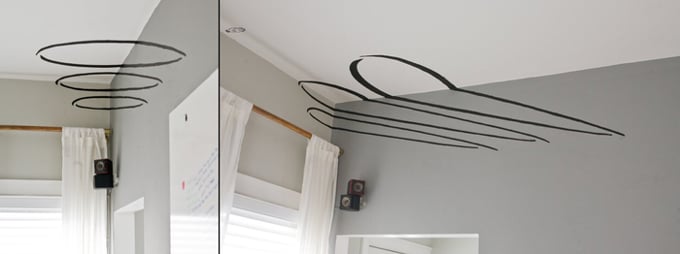
An early anamorphic illustration, painted in my house in 2017. (Thanks Isaac!) From anywhere else, it's just a tangle of lines — but stand in the right spot, and everything clicks into place.
One of the most iconic examples of anamorphosis comes from Hans Holbein the Younger's 1533 painting The Ambassadors . Across the bottom of the canvas, there's a grey smear — meaningless at first glance. But from an oblique angle near the edge of the room, that smear becomes a perfect skull. It's a hidden memento mori , a reminder that whatever power or knowledge The Ambassadors may hold, it all fades in time. Death winks at you from the corner. Bam!
That strange smear at the bottom? Viewed from the right angle, it's a skull.
What I discovered with Impossible Corners is that by designing directly into the geometry of the corner — where the three walls meet — I could create something new: a shape that appears to rotate as you move, no longer tied to a single viewpoint. The illusion becomes room-wide , and your entire 3D perception flips, no matter where you're standing.
_________
You might recognize the image below — a classic Impossible Object . Popularized by Oscar Reutersvärd, these are shapes that seem plausible at first glance, but on closer inspection, defy the rules of 3D space. They exist only in the mind's attempt to resolve the impossible.
I consider these another ancestor of Impossible Corners — flat drawings that trick the mind into building impossible forms from believable cues.
An Impossible Object.
It takes a lot of paper + paste + scissors to design a piece like this!
MATERIALS + MEASUREMENTS
The illusion spans three walls — but most vinyl is way too sticky for indoor use — it can damage paint or leave residue when removed. We spent a long time sourcing a high-quality, repositionable vinyl that allows easy installation and clean removal — even reuse in another location.
The dimensions of our three designs are included below:
INSTALLATION
Installation is simple: use a ladder to access the corner, and apply the six decals. It takes me about 8 minutes, but if you have high ceilings or limited ladder experience, it may take longer. I recommend having someone assist.
No tools are required beyond a ladder — though a soft-edged scraper (or even a credit card) can help press the vinyl more securely onto the wall.
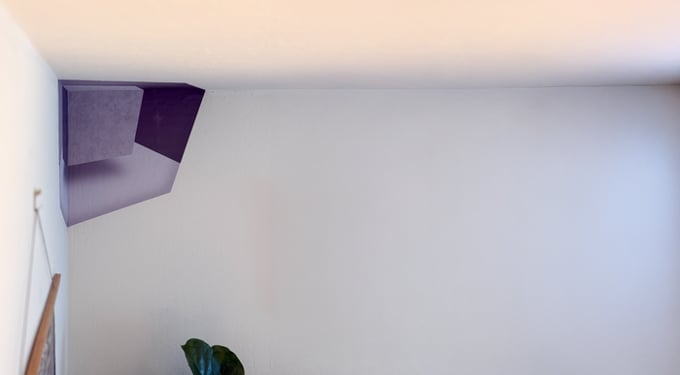
A flat print that rewires space. This is what one full Impossible Corner looks like before installation.
YOUR WALL SMOOTHNESS MATTERS
Wall texture plays a big role in the longevity of this piece.
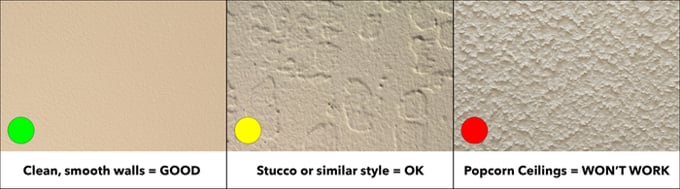
Smooth surfaces like well-painted drywall are ideal. Some light to medium textures (eg light stucco) can still hold, but heavily textured surfaces like popcorn ceilings are not suitable — the vinyl will not adhere reliably.
Please check your wall and ceiling finish before purchasing. If you're unsure, feel free to reach out with a photo — we're happy to hold you confirm whether it will work in your space.
Check your wall texture before installing — surface finish affects adhesion.
WHO'S IT FOR?
Impossible Corners are designed for a wide range of environments — from homes to shared spaces — and thanks to the removable adhesive, they're renter-friendly too.
Some perfect fits:
Lovers of design, illusion, and optical art
People who like to geek out on the nature of reality — and feel it for themselves.
College dorms looking for a mind-bending centerpiece
Children's play areas filled with curiosity and imagination
That unusual, wonderful person in your life who seems impossible to shop for :)
WHAT PEOPLE ARE SAYING
"I'm always looking for ways to make more contact with magic and delight. This feels like one of the simplest and most powerful ways to bring that feeling right into my living room." -MK
"It's such a simple and brilliant way to transform a wall into the centerpiece of the room. It's the first thing that every guest wants to know about — and an awesome conversation starter.” - SM
“The more I look at them, the more Impossible Corners blow my mind. I can't see the 'real' corner anymore - even if I try. My mind has been completely turned upside down, or inside out as it may be. What I love is that it's not just an entertaining illusion, but a profound pointer to how the mind constructs experience.” -JB
🌟 Final Note
This wall installation isn’t just decoration — it’s an experience that invites viewers to question what they see. By reshaping perception rather than space itself, it brings wonder, curiosity, and artistic depth into any room. A bold statement for those who love art that makes you think. ✨
✈ Worldwide Shipping
Please do note that shipping is insured. However, you may receive your items earlier. Tracking Numbers will ALWAYS be sent so you can track it every step of the way! Cool things are worth waiting for! 😉
OUR GUARANTEE
📦 Insured Worldwide Shipping: Each order includes real-time tracking details and insurance coverage in the unlikely event that a package gets lost or stolen in transit.
✉️ 24/7 Customer Support: We have a team of live reps ready to help and answer any questions you have within a 24-hour time frame, 7 days a week.
🔒 Safe & Secure Checkouts: We use state-of-the-art SSL Secure encryption to keep your personal and financial information 100% protected.
💖Our original intention
Provide interesting, fashionable and high-quality products in the world. We will do our best to provide customers with excellent customer service support, because we attach great importance to absolutely zero-risk customer satisfaction.